
Lennokkaita tutkimuksia kolmannelle vuosituhannelle.
Bumblebees beat their wings about 200 times a second. Their thorax muscles do not expand and contract on each nerve firing, but rather vibrate like a plucked rubber band. This is efficient, since it lets the system consisting of muscle and wing operate at its resonant frequency, leading to low energy consumption. Further, it is necessary, since nerves cannot fire 200 times per second. These types of muscles are called asynchronous muscles and are often found in insect wings.
...
One common, yet incorrect, assumption is that the buzzing sound of bees is caused by the beating of their wings. The sound is actually the result of the bee vibrating its flight muscles, and this can be achieved while the muscles are decoupled from the wings. This is especially pronounced in bumblebees, as they must warm up their bodies considerably to get airborne at low ambient temperatures.Bumblebees have been known to reach an internal thoracic temperature of 30°C (86°F) using this method.
http://en.wikipedia.org/wiki/Bumblebee
Arthur Ahon vinkkejä (Ralph Ringin 2011 haastattelun mukaan)
So in a sense that was the day I decided to go back to nature and learn my lesson. I eventually ran into in fact along with Otis Carr we had many other people working with us one was a retired Intelligence Officer in the ARMY his name was Wayne Aho and he had a brother by the name of Arthur Aho. And they were both from Finland and very, very sharp people. Arthur Aho wrote a book and it is still in the Library of Congress I believe it can still be obtained and it was called Tomorrow's Energy Need Not Be Fuel by Arthur Aho. And when I met Arthur and I told him about the bumblebee he said, No, no, no you have got to give credit where credit is due. Your teacher was absolutely right aerodynamically they can't fly. And I said well explain to me what the difference was and he showed me in his diagrams and so forth that the bumble bee has a fastened or connected to a part of his larynx a little hollow tube and he referred to this as a resonator cavity. And he said by the humming bird beating its wings so many cycles per second it would reach a resonant frequency, because of the resonator cavity, it would bounce back and forth similar to the feedback we get on a microphone which we had before starting here today. It would reach the resonant frequency of the Earth's spin, 7.8 or whatever it happened to be, and he would create his own, he would free himself from what's called gravity and create his own force field around himself and levitate. And so in essence bumblebees really don't fly they actually levitate by creating their own magnetic force field around themselves by the beating wings reaching the resonant frequency et cetera et cetera et cetera.
http://hello-earth.com/otistcarr/venust ... hour5.html
Lisäksi lentävä kimalainen muodostaa alapuolelleen pulssinomaisesti toroidimaisia ilmanpyörteitä, jotka puolestaan muodostavat sähköisiä potentiaalieroja pyörteen keskuksen ja reunojen välille.
Willmer P, Stone G & Johnston I. 2000. Environmental Physiology of Animal. Blackwell Publishing, Malden.
http://685489795474832153.weebly.com/wi ... amics.html

Ilmanpyörteessä on noin 78 % typpeä (tiheys 1.25) ja 21 % happea (tiheys 1.429).
Jos toroidinen ilmanpyörre on keskihakuinen, raskaammat elementit siirtyvät kohti pyörteen keskustaa, kuten Viktor Schaubergerin kaksoisspiraaliputken virtausdynamiikassa negatiivinen carbonekonsentraatti (arvioitu tiheys noin 2 x 10³) ja tiheä kylmä ydinvesi siirtyvät pyörteen keskukseen samalla, kun kevyempi happikonsentraattivesi pyörii sen ympärillä. Pyörteen keskukseen imeytyvät myös raskaat uppotukit, erityisesti viileinä täydenkuun öinä, kun virtaavan veden lämpötila on +4°C anomaliatilassa.
Samoin periaattein toroidisessa ilmanpyörteessä raskaampi happi voisi mahdollisesti siirtyä pyörteen keskukseen ja kevyempi typpi pyörteen reunoille. Hapetuslukujen perusteella ilman reaktiivinen happi varautuu negatiivisesti ja passiivinen typpi positiivisesti. Tällöin lennossa positiivisesti varautuvan kimalaisen alapuolelle muodostuvien toroidien pintavaraus olisi positiivinen ja sähköstaattiset poistovoimat voisivat auttaa kimalaista lentämään.
Mekaniikka taulukot (paljon hyödyllistä tietoa)
http://www.taulukot.com/index.php?searc ... ynamiikka&
Asiaan liittyvää
Scientists have, however, known about the electric side of pollination since the 1960s, although it is rarely discussed. As bees fly through the air, they bump into charged particles from dust to small molecules. The friction of these microscopic collisions strips electrons from the bee’s surface, and they typically end up with a positive charge.
Flowers, on the other hand, tend to have a negative charge, at least on clear days. The flowers themselves are electrically earthed, but the air around them carries a voltage of around 100 volts for every metre above the ground. The positive charge that accumulates around the flower induces a negative charge in its petals.
Bees Can Sense the Electric Fields of Flowers by Ed Yong 2013. National Geographic.
http://phenomena.nationalgeographic.com ... f-flowers/
The positive charge on an insect such as a bee or fly attracts the web, which is normally negatively or neutrally charged, increasing the chances that an insect flying by will contact and stick to the web, said UC Berkeley post-doctoral fellow Victor Manuel Ortega-Jimenez.
Spider webs more effective at snaring electrically charged insects
http://newscenter.berkeley.edu/2013/07/ ... d-insects/
The effects of electrical charge on spider orb webs are unknown. Here, we evaluated the deformation responses of spider webs as induced by statically charged insects and water drops.
...
Risk of capture for a free-flying insect may correspondingly be enhanced given that the induced deformations observed here are comparable to the average mesh spacing for cross-spider webs (~2 mm).
Spiderweb deformation induced by electrostatically charged insects
Victor Manuel Ortega-Jimenez & Robert Dudley 2013.
Scientific Reports 3, Article number: 2108
http://www.nature.com/srep/2013/130704/ ... 02108.html
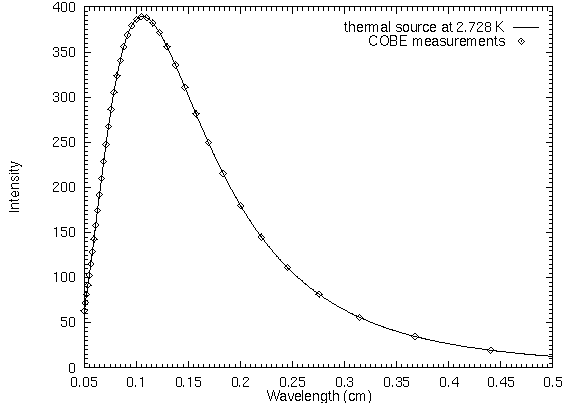
Mielenkiintoisena huomiona 1 mm resonoi kosmisen taustasäteilyn huipun kanssa. Sen pituisia aaltoja on koko maailmankaikkeus täynnä.
Tässä kuva spektristä http://www.astronomynotes.com/cosmolgy/cmbr.gif
Tutkimuksia helmikuulta 2013
Georges Lakhovskyn (1925) kokeilujen mukaan ilmakehässä liikkuvat elävät olennot, etenkin hyönteiset ja linnut varautuvat sähköisesti monesti hyvin korkealla potentiaalilla.
Sähköisesti varautunut ilma synnyttää lentävän linnun sulkiin negatiivisen varauksen samankaltaisesti kuin kissaa silittämällä. Näin voi päätellä hankaussähkö-ilmiön ja triboelektrisen sarjan perusteella.
Tämän tueksi löysin Washingtonin yliopiston bioinsinöörikurssin the birds and the bees -materiaalin, jossa kerrotaan lintujen varautuvan lennon aikana negatiivisesti, joka puolestaan edistää lentämistä. http://courses.washington.edu/bioe555/Lecture7.pdf
Kun nyt kolibritkin tekevät samankaltaisia pyörteitä kuin kimalaiset ja linnunsulat varautuvat negatiivisesti, hypoteesin mukaan varautuneet ilmanpyörteet vetäisivät kolibreja alaspäin. Vai onko kolibrien mahdollisessa painovoimakytkennässä sen verran suurempi noste, että sähköstaattisesti alaspäin vetävät ilmanpyörteet tasoittavat ja vakauttavat niiden paikallaanlentoa? Vai olenko taas päätellyt liian suoraviivaisesti?
Pitänee varmistaa ilmanpyörteen sähköinen varautuminen. Voihan olla, että sähköstaattisen induktion johdosta pyörteiden ulkoreunat varautuvat linnuilla positiivisesti ja hyönteisillä negatiivisesti, jolloin pyörteiden reuna-alueet eivät ainakaan sähköstaattisesti auttaisi lentämistä, vaan päinvastoin.
Toisaalta, jos tällöin lintu tai hyönteinen lentää sähköisesti varautuneen toroidipinon keskellä, jonne sähköstaattisen induktion johdosta syntyy vastakkaismerkkinen varaus, se voisi edistää sekä linnun että hyönteisen lentoa. Lisäksi tällainen varausjakauma saisi toroidin keskuksessa ilman virtaamaan tehokkaammin alaspäin, koska samanmerkkiset varaukset hylkivät toisiaan.
New Scientist, 11 October 1997, s. 27.


Hyönteisten ja lintujen lentämisen sähkömekaanisissa periaatteissa näyttää olevan opittavaa ja värähtelevissä resonanssionteloissa ja sähköisissä toroideissa potentiaalia.